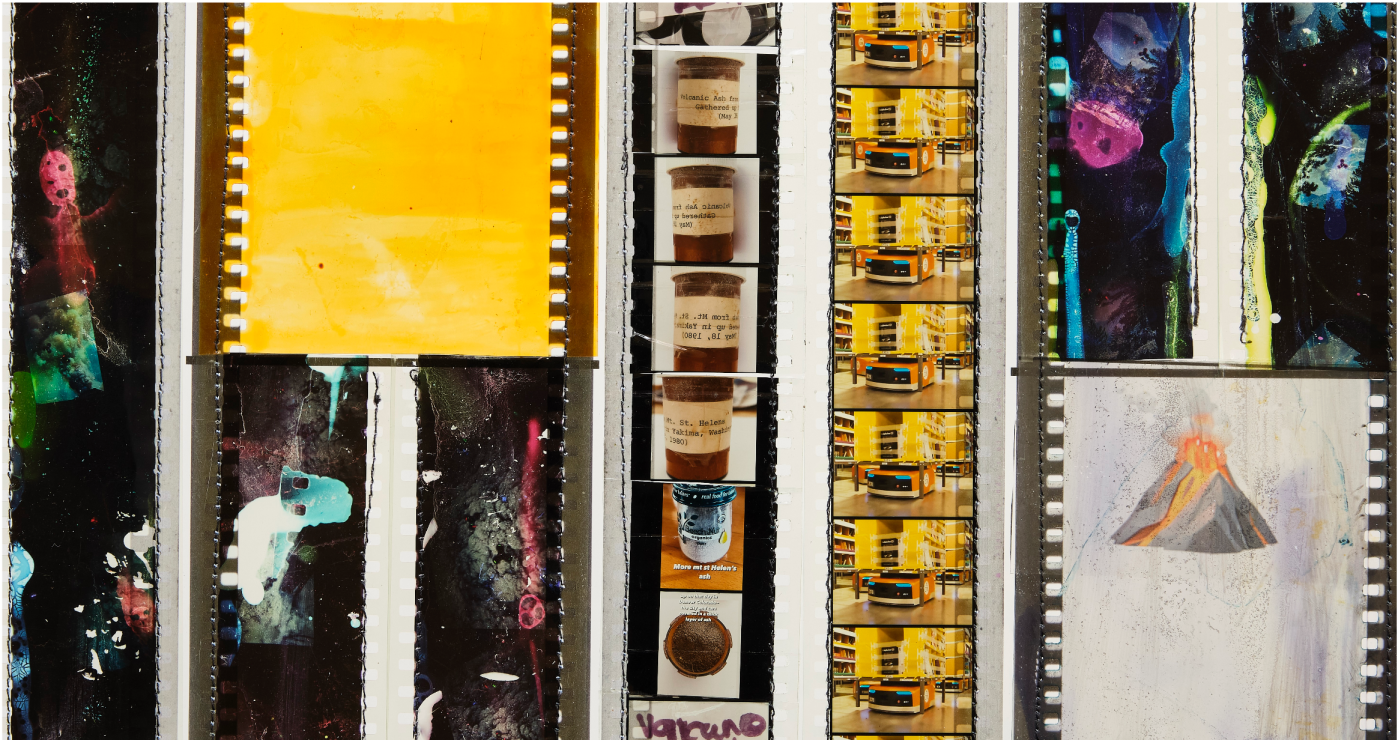
The culmination of my curatorial residency at the Govett-Brewster Art Gallery | Len Lye Centre, this is the first major exhibition dedicated to the reciprocal relationship between animation and textile art. Transforming the centre into a series of gallery and cinema spaces, Interlaced: Animation and Textiles brings together moving-image works fashioned from textile forms and materials alongside fibre works inspired by animation. Artists featured in the exhibition explore ways of embroidering with projected light, quilting celluloid films, and weaving digital tapestries.
ARTISTS:
Faig Ahmed (Azerbaijan), Danielle Brathwaite-Shirley (UK), Jon Michael Corbett (Canada), Kelly Egan (Canada), Sione Faletau (Aotearoa, Tonga), Footprints Studio (UK), Sabrina Gschwandtner (USA), Marguerite Harris (France), Len Lye (Aotearoa), Aubrey Longley-Cook (USA), Jodie Mack (USA), Huw Messie (USA), Lindsay McIntyre (Canada), Miracle de Mille (France), Ng’endo Mukii (USA), Kate Nartker (USA), Ishu Patel (Canada), Pathé Studio (UK), Izabella Pruska-Oldenhof (Canada), Harry Smith (USA), Caitlin Thompson (Canada), Vaimaila Urale (Aotearoa, Samoa), Jennifer West (USA), Jordan Wong (USA), Shaheer Zazai (Canada), Studio Zeitguised (Germany)
Installation images:


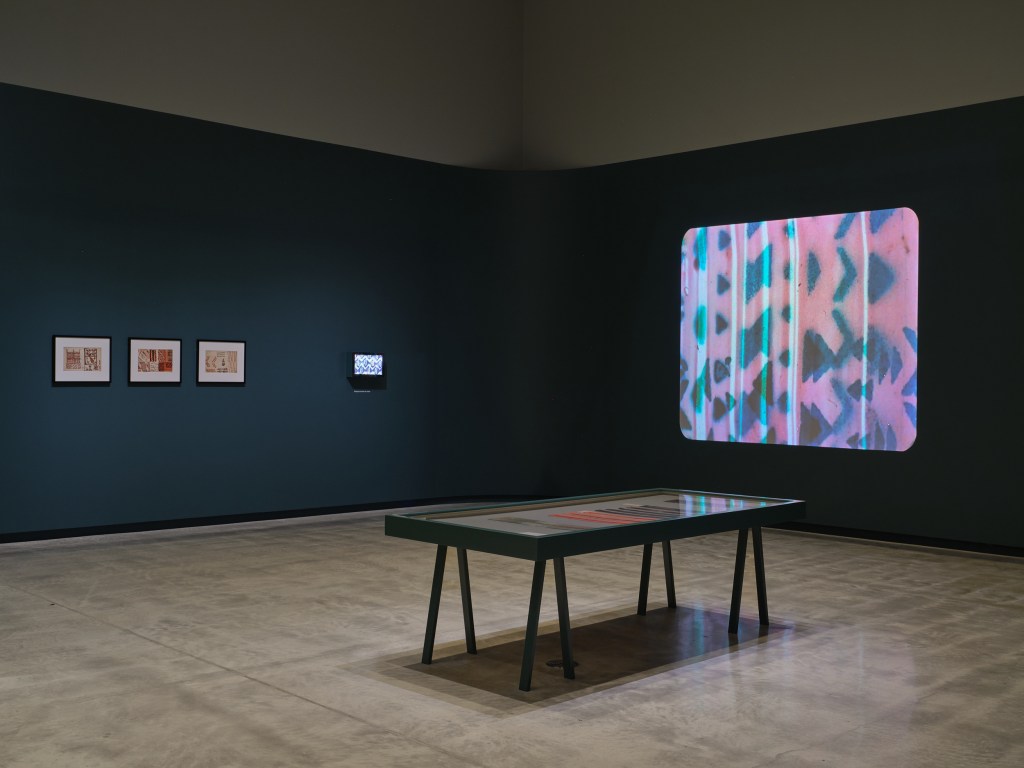
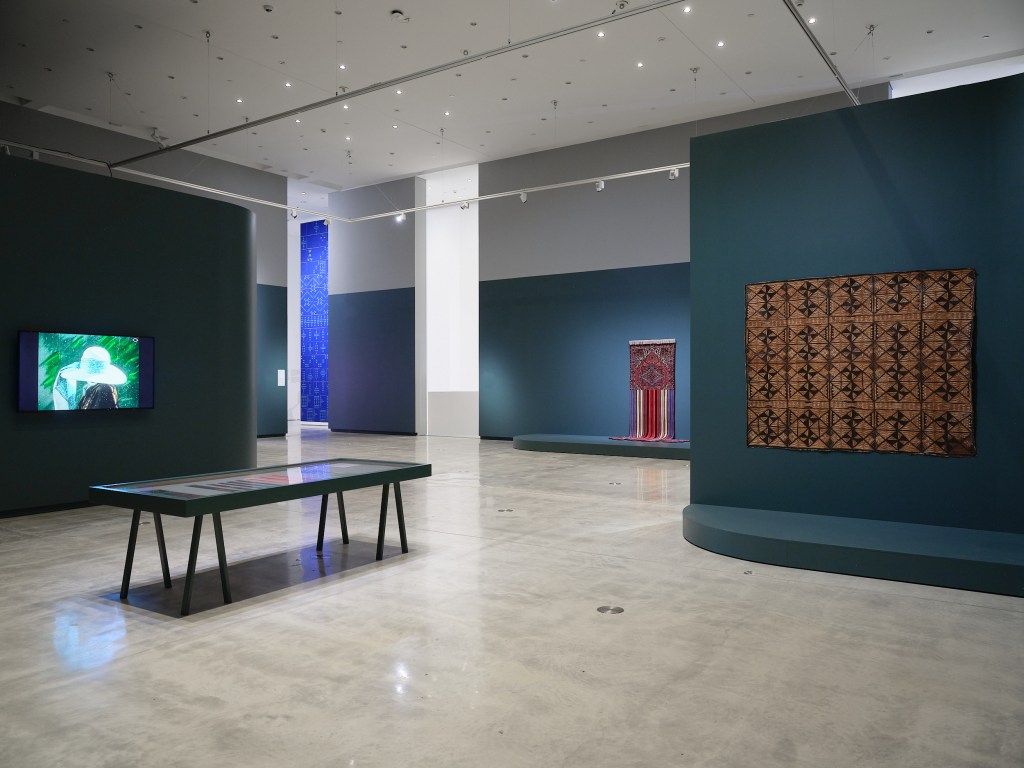
Above: installation images of of the exhibition Interlaced: Animation and Textiles at the Len Lye Centre, 2024. Photographs by Sam Hartnett.
Placing moving images in a textile lineage:
The work of renown experimental filmmaker Len Lye (1901-1980) plays an important connective role in the exhibition. Interlaced makes a compelling case for the influence of Pacific barkcloth and European textile production on Lye’s innovative animation techniques, which treated the celluloid filmstrip as a pliable decorative surface. Nesting Len Lye’s animated films in a broader field of analogue and digital media, Interlaced explores the enduring capacity of textile forms to make visible animating forces and to reanimate intergenerational cultural memory.

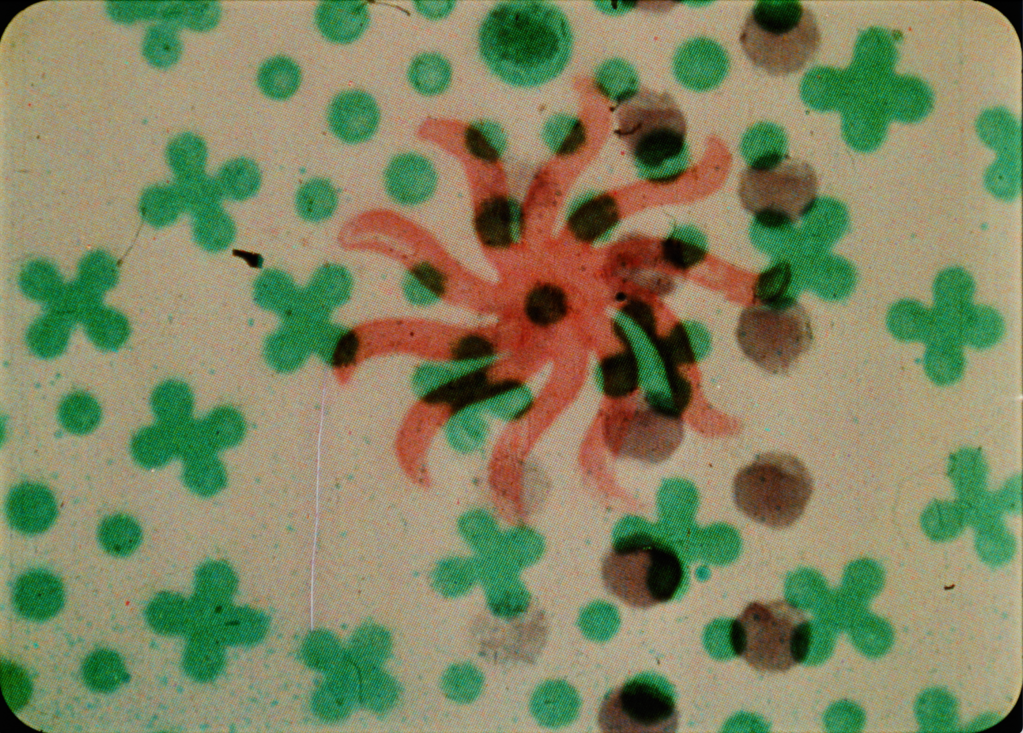


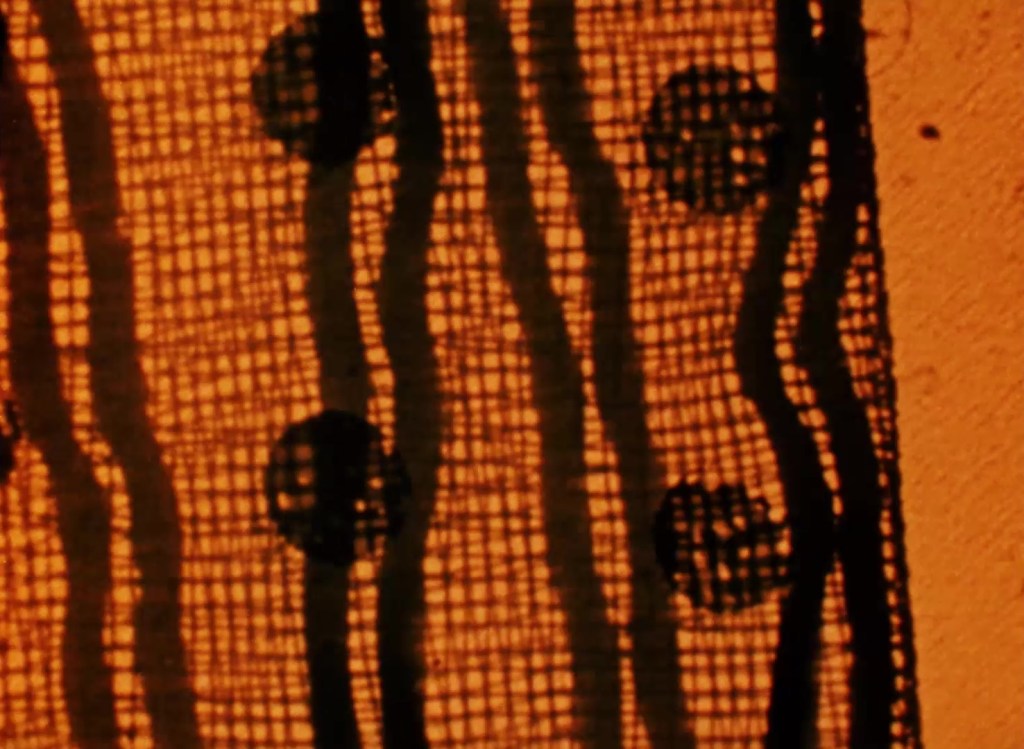
Above: Frames from Len Lye Kaleidoscope (1935), top row, and Color Cry (1953), bottom row. Film prints courtesy the Ngā Taonga film archive.
Tracing animate patterns across the two art forms:
Exploring the reciprocal connections between animation and textiles, Interlaced introduces two newly commissioned works by Aotearoa artists engaging with Moana (Pacific Ocean) textile traditions: Vaimaila Urale and Sione Faletau. Vaimaila Urale’s O Le Sami Po Uliuli (2024) reminds us of the animated qualities of textile materials and patterns, which come alive on the body, in ceremony, and in the built environment. This new work expands Urale’s established practice of using a selective set of ASCII characters found on all computer keyboards to compose intricate patterns that encode Samoan symbolism of tattooing and siapo (barkcloth) design. What appears from a distance as a glowing blue screen is revealed in proximity to be a coordinated multiplicity of 180 sovereign cloth tiles, breathing collectively on the architectural surface. Titled after the sea darkened by night, the composition submerges visitors underwater to experience the recurring patterns of migration and predation that affect the Moana.
Below: Vaimaila Urale’s O Le Sami Po Uliuli at the Len Lye Centre, 2024. Photo by Sam Hartnett.

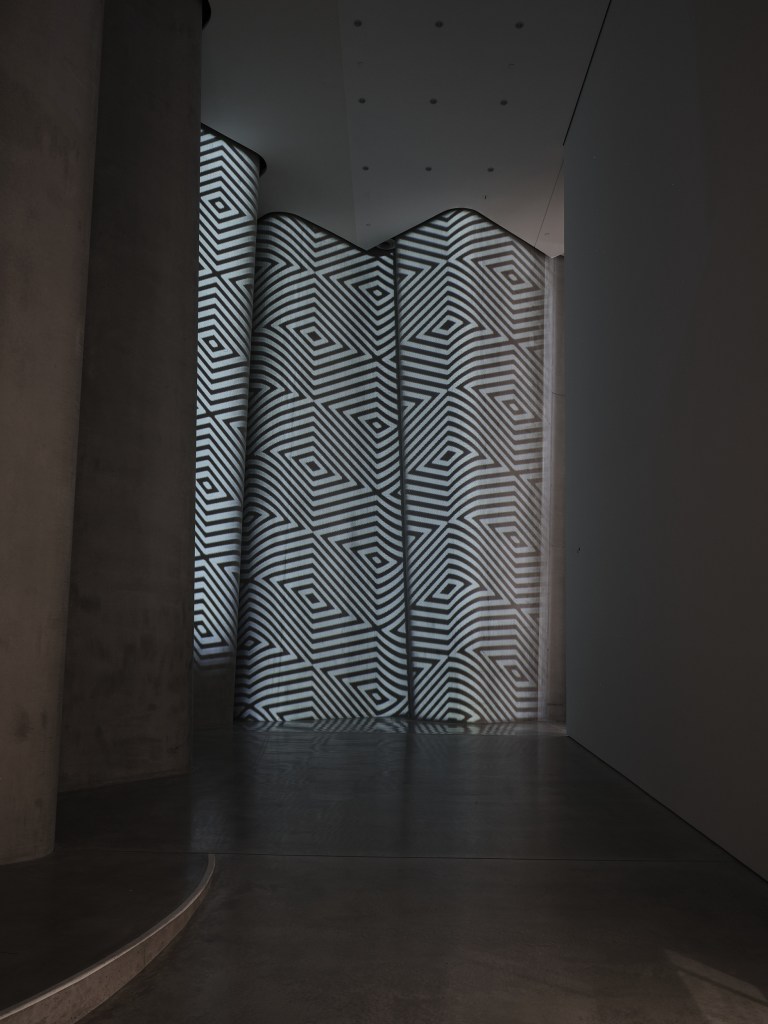
Sione Faletau’s Peau Lalava o Moana – The Moana that Binds Us (2024) transforms the Len Lye Centre’s famous architectural concrete curves into a digitally animated weave that envelops bodily perception. This animated work translates the soundwaves of the Moana (Pacific Ocean) – recorded near the gallery – into rhythmic digital patterns informed by kupesi (pattern designs) found in Tongan ngatu (barkcloth) and lalava (architectural lashing) artforms. Kupesi patterns provide a tangible lineage that entwines the Tongan diaspora across geographic and cultural borders.
The word lalava refers to the interlacing of two strands (la / la) across the space between (va). Lalava embodies the idea that strong cultural and social ties are not inherently given. Like architectural joints, they must be reinforced through a process of active binding. With Peau Lalava o Moana – The Moana that Binds Us, Faletau binds together visual and sonic perception with the space of the gallery and its situated place within the Moana.
Below: Sione Faletau’s Peau Lalava o Moana – The Moana that Binds Us at the Len Lye Centre, 2024. Photo by Sam Hartnett.
Braiding together contemporary animation and textile art, Interlaced highlights the influence of textile history and culture on artisanal media production.

 Alla Gadassik: Media Scholar and Animation Curator