
It was an honour and delight to receive an invitation from the famed GEIDAI animation program at Tokyo University of the Arts, to serve as an international reviewer for their Masters thesis projects. This animation school is bursting with creative energy, storytelling sincerity, and — under the leadership of the brilliant Koji Yamamura — fully committed to artisanal animation.
Continue reading “International Thesis Review: Tokyo University of the Arts”
This public talk (19-May-2024) introduces Maya Deren’s film Meshes of the Afternoon and Věra Chytilová’s film Daisies at VIFF, as a continuation of their popular Pantheon series dedicated to the Sight & Sound list of “greatest films of all time.” What do these two films have in common, other than being directed by women? I look forward to offering some framing remarks and hearing from audience members during the post-screening discussion. Screening time and tickets are available here.

How can researchers and artists develop meaningful ethical practices around storytelling methods? What responsibilities do researchers and creative practitioners have to participant stories they gather, store, and share? This virtual roundtable, presented by ECU’s Research Ethics Board, features speakers Aaron Nelson-Moody (Coast Salish art and design), Candace Brunette-Debassige (Indigenous education and academic policy), and Ranjan Datta (community-based disaster research). It was an honour to organize and facilitate this virtual roundtable as part of my work with the ECU Research Ethics Board.
Continue reading “Virtual Roundtable: Ethics of Storytelling”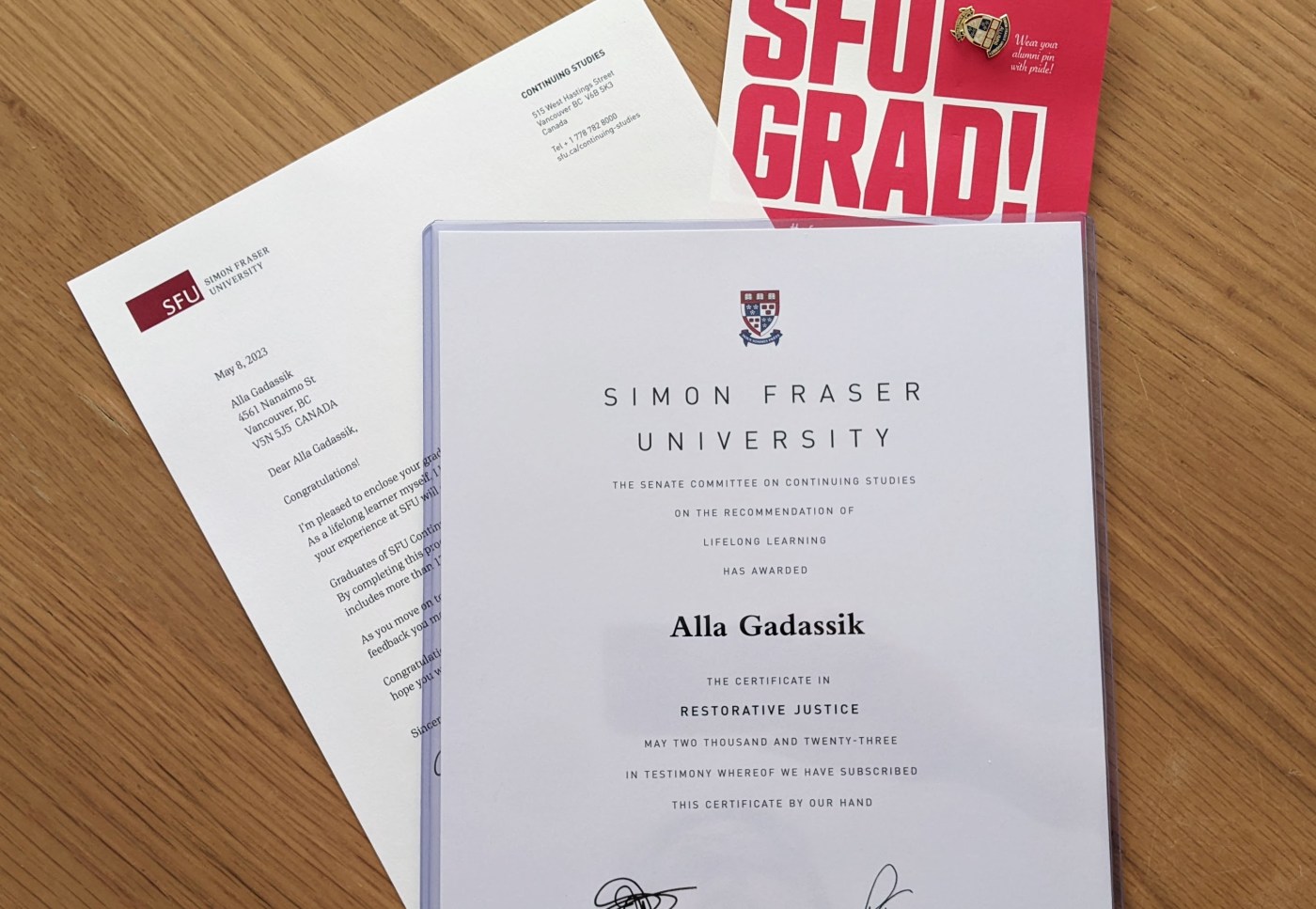
It’s official, I completed my Certificate in Restorative Justice (focus on Education)! This program is designed with an option to complete in one year, but it took me three years — between raising the funds, allowing myself time to really process the material, and coping with unexpected developments at my institution (which served as the primary case study and focus of my coursework). While the program itself was not necessarily a good fit, studying with Christianne Paras and Krystal Glowatski was a privilege. These amazing mentors were careful to remind us that restorative justice is not a panacea, particularly when it comes to contending with systemic and institutional violence. Everything I’ve learned has been transformative for my relationships with students, my classroom spaces, and the kinds of collegial initiatives I’ve sought out since then. I also get a kick at adding SFU to my list of ‘alumna’ institutions.

Bella Blanca and Kelsey Brill-Funk took part in my “Material Animacy” course last year, which is linked to the Animate Materials Workshop but is open to artists working in any media. Bella chose bone as their material collaborator in ceramics, whereas Kelsey pursued a deep dive into hair as a photographer. This month, their work that emerged from the course was featured in a two-artist exhibition Flesh & Bone. I was proud and happy to have written the exhibition text for this show.
Continue reading “Exhibition: “Flesh & Bone: Bella Blanca and Kelsey Brill-Funk””
When do feminist artists put their body on the line? Is decolonial feminist art praxis possible in the art institution?
“Art in the Flesh: A Public Class” was a two-part special event co-organized by Dr. Sue Shon and me for This Exhibition is not an Exhibition (curated by Valérie Walker and Patryk Tom) at the Libby Leshgold Gallery in Vancouver (Canada). Our two public classes within the gallery space were an experiment to imagine and practice an anticolonial pedagogy that bridges, among other contradictions, the arts university and the arts gallery.
Continue reading “Event: “Art in the Flesh: A Public Class””
As a writing genre, the academic cover letter is surrounded by too much mystery, and it elicits unmerited levels of anxiety. Since we’re talking about academic writing in general, that’s saying something. As part of my fellowship at Northwestern University’s Graduate Writing Place, I developed a professionalization workshop on the dreaded “job letter,” geared specifically toward students in my department of media studies. Continue reading “Workshop: “Writing the Academic Cover Letter””

The foundation course “Analyzing Media Texts” at Northwestern University’s School of Continuing Studies was my first time working with returning and mature students, and it was very rewarding to have a classroom with such a range of life experiences and an open-minded approach to the diverse films we watched. My personal highlight was our field trip, which took place during the week we studied documentary cinema. I’ve never tried to do a field trip for a film analysis class before. We watched Chasing Ice at the Music Box theatre, with the additional challenge of taking notes during a public screening. Then we went to a cafe to talk about how the film used formal techniques to show the long-term impact of climate change.
Image above is from Chasing Ice (2012), directed by Jeff Orlowski
I first developed and ran the workshop “Writing about Audiovisual and Ephemeral Objects” for graduate students at Northwestern University in 2012. The workshop focused on strategies that scholars can use in note-taking, describing, and writing about objects that are often inaccessible after one viewing. We also looked at different ways of making ephemeral objects come alive in the mind of the reader, who may never get a chance to see them at all. Continue reading “Workshop: Writing about Audiovisual and Ephemeral Objects”

 Alla Gadassik: Media Scholar and Animation Curator