
In my role as Chair of the ECU Research Ethics Board for the past three years, I organize an annual educational event related to the ethics of creative research and practice. This year’s event featured a conversation with Dr. Charlotte Schallié from Survivor-Centred Visual Narratives about working with survivors of violent trauma and atrocity. While we do not record our events, I wrote a post covering some key points that came up in the conversation and audience discussion that followed. Dr. Schallié commissioned ECU student Hannah Strocel to develop illustrations for the text, and it’s now published on the SCVN website here.
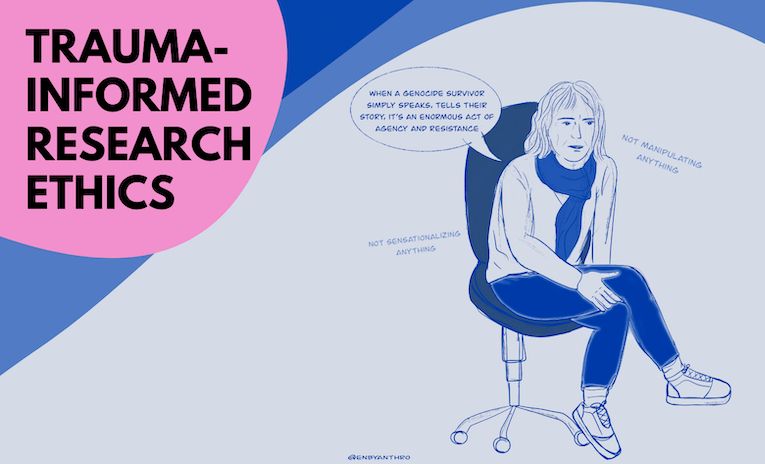
Organized in my current role as Chair of the ECU-Research Ethics Board, I invited Dr. Charlotte Schallié, co-director of the Survivor-Centred Visual Narratives project, to speak about ethics of arts-based research with survivors of violence and mass atrocity. Our conversation focused on ethical considerations and protocols of arts-based research with trauma survivors. This hybrid event took place 02-09-2026 at Emily Carr University and online. An illustrated essay was subsequently published online.

How can researchers and community-engaged artists centre accessibility and equitable participation of disabled participants, when selecting research or creative methods, designing their recruitment materials, or establishing consent processes? What responsibilities should researchers and creative practitioners have to disabled participants, whose experiences or stories they solicit or share? This virtual roundtable, presented by ECU’s Research Ethics Board (February 11, 2025), featured three participants speaking through lenses of crip theory, health design principles, and disability advocacy in the arts.
Continue reading “Virtual Roundtable: Ethics of Accessibility”

